Asset UPnP ™


O
verview

Asset is a UPnP / DLNA server, UPnP is a method of sharing media content between devices. Typically audio tracks are stored on a computer, server or NAS, multiple audio devices around the home network can play audio from the UPnP server (devices such as Linn DS, XBox 360, PS3, etc).

Asset features:

  • Album Art support,
  • Internet Radio: browse popular stations from around the world,
  • Dynamic playlists: find newest, least or most played tracks & albums. Jukebox (random) selection,
  • Customizable browse tree with advanced search facilities (Album by Release, Style, Composer, Conductor...),
  • Configurable Wave / LPCM decoding (often called transcoding) for devices which cannot play specific audio types,
  • ReplayGain can be applied to transcoded Wave / LPCM stream, volume matching across tracks for devices which have no support,
  • Extensive tagging 'standards' compatibility,

Version Differences

Asset is available as free (limited functionality) or registered (complete features), version differences:

Feature Free Premium Registered
UPnP Server X X
Internet Radio   X
Dynamic Playlists   X
Jukebox Random Selection   X
Browse by File & Folder   X

Register Premium Asset UPnP online
 
Tip: upgrading from Asset v1? add new v2 features (Internet Radio, etc..) to the browse tree in Asset Configuration >> Advanced Settings Edit

Installation

Typically Asset UPnP is installed by:

  • Download the Asset UPnP installer (AssetUPnP-WHS.msi), save this install to your PC, do not run it,

  • Look in Computer >> Network for your Windows Home Server Machine, browse to the folder: \\[servername]\Software\Addins (if asked for a username and password, enter Administrator and the password used to setup the WHS machine)

  • Copy and Paste the AssetUPnP-WHS.msi (or the registered install) install to the folder: \\[servername]\Software\Addins,

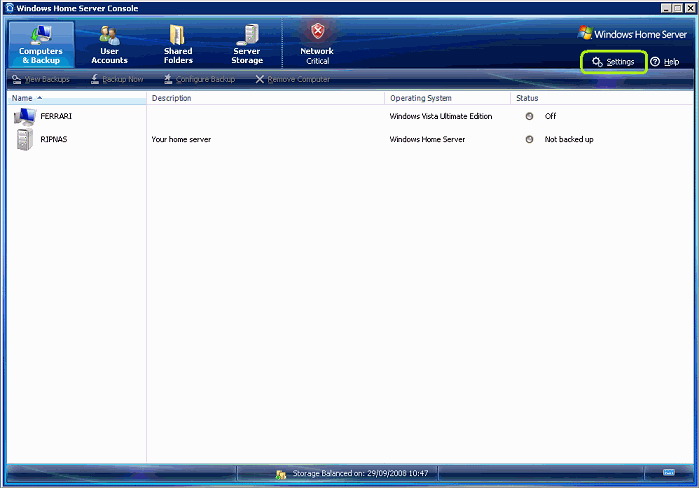
  • Start Windows Home Server Console and click Settings:

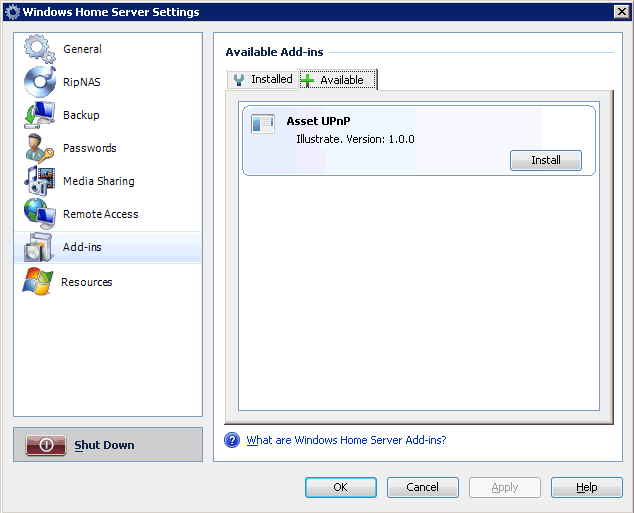
  • Choose Add-ins. Note if installing a registered Asset UPnP where there is an existing unregistered trial of Asset, the existing Asset should be uninstalled (from the Installed Tab click Uninstall), before installing the registered Asset.

    Click the Available tab, then Install (next to Asset UPnP):

  • After approximately 1 minute installation will be completed (with a message Installation Succeeded and the offer to restart the Windows Home Server Console, click Ok).

Straight after installation Asset is fully operational automatically sharing all tracks contained in the Music share folder (taking a few minutes to scan the tracks and add them to the library). Asset watches the Music folder for changes and updates automatically.

Asset is accessed directly from the device (such as XBox, PS3) or through UPnP Control Point software running on a PC (such as Linn's Kinsky Desktop) or hand-held Controller (such as Songbook or PlugPlayer on the iPod Touch & Phone). Asset will appear on your UPnP control point as Asset UPnP: [Computer Name], select Asset to browse for audio tracks:

Artist
Album
Title
Genre
Style
Composer
Year
Internet Radio [RadioTime]
Playlists
Advanced Search
[Details]

From here your audio collection can be browsed (by artist, album, etc). At the top of many listings are [A to Z], selecting this allows the quick selection of an item based on the first letter, useful when there are 1000's of artists or albums. [Album] is also presented when browsing Artists, this switches the view to Album rather than listing all the individual tracks from an artist.

Playlists item allows the selection of:

  • Jukebox Track Selection: a random selection of tracks (based on rating, ie the more popular tracks appear more than less popular tracks),
  • Previously Played Tracks: ordered list of last played tracks,
  • Recently Added...: last 100 tracks or albums added to the library,
  • Most Played...: tracks or albums with the highest play count,
  • Least Played...: 100 tracks or albums which have been played the least.

Internet Radio [RadioTime] enables browsing of popular radio stations by Genre or location, a favourite list of stations can be created on the web site www.radiotime.com and assigned to a user name which can be entered into Asset Configuration (see later) to allow access to these favourite stations.


Advanced Configuration

Asset can be configured from the Windows Home Server Console >> Settings >> Asset UPnP:

Asset version is displayed, if there is an update to Asset, an offer to install the update will be shown.

Asset can be switched On, Off or Restarted. Asset watches the Music share for changes and updates automatically, it is also possible to force a rescan of the library with Rescan Library (Refresh All rescans the whole library from scratch).

To change advanced settings click Edit:

Audio Library

The WHS Music shared folder is automatically monitored, so no changes should be required.

Exclude Audio Types can be used to inform Asset not to add certain types of audio files (for example your library consists of FLAC lossless files and mp3 files created from the FLAC files, in this instance mp3 should be excluded).


General Settings

The [Artist] to [Artist], The  allows the browsing of 'The Beetles' under B

Multi-Disc Albums show as '[Disc] [Track] [Title]'  many albums are released as multi-disc-albums, such as a Greatest Hits collection. Normally one album would be listed 'Greatest Hits' and tracks from disc 1, 2, 3 are all present under the same album (3 track 1's, not good). With this option checked there each album would follow in the correct order in one album folder.

Multi-Disc Albums show as 'Album, Disc x'  many albums are released as multi-disc-albums, such as a Greatest Hits collection. Normally one album would be listed 'Greatest Hits' and tracks from disc 1, 2, 3 are all present under the same album (3 track 1's, not good). With this option checked there would be 3 albums presented 'Greatest Hits, Disc 1', 'Greatest Hits, Disc 2', etc.

Size Album Art 160x160  check this option if your audio files have high resolution album art and browsing though a hand-held controller, the reduced size will give quicker responses.

Contributing Artists with Main Artists  typically audio tracks might include featured artists (multiple artists), normally contributing artists are searched through Advanced Search >> Contributing Artist, with this option checked these 2nd artists are added to the main Artist browse.

Dynamic Playlist Item Count determines the number of items to present in the dynamic playlists (such as newest tracks)

RadioTime Username allows favourite radio stations to be added an a user account (free to create) on http://radiotime.com/, type the user name into asset to access these favourites.

 
Browse Tree

Asset allows customization of the browse tree, simplify it by removing items, or add new browse-able items.

New items are added with
Add New Container, the exact position of insertion is then specified. After the item is added change it's name to the type of item that is browsed by, a generic [A to Z] can be added into containers to allow browsing of [A to Z].

A further option is available for each container item:

  • Display All no limitation of track or container listings
  • No Track Listing (shown with blue icon) prevents track listings, an example of this is 'Title' which has this set, selecting title then allows selection of A to Z, then tracks are listed.
  • No Container Listing (shown with blue icon) prevents listing of the actual container items, an example is the Artist item (when the Hand-Held Controller default is selected), No Container Listing is selected for Artist, which prevents all artists from displaying when artist is selected, A to Z is then selected to speed-up selection (instead of waiting for all artists to display).

Restore Default allows the restoration of the Browse Tree to default settings, or a Hand-Held optimized listing restored.

Wave Streaming (including ReplayGain support)

Asset is able to decode audio prior sending to a player, this would be useful if:

  • The player does not support the audio format directly, Asset is able to allow the player to play the audio tracks by decoding them to PCM (either Wave or Linear). Note that decoded audio files have no quality loss, they are as the player would play them (when it decodes), Place a check mark next to the format which is not supported by your player (such as AIFF)
  • Enable Apply ReplayGain to work with a player which is not ReplayGain compatible. ReplayGain is a method of measuring loudness of audio tracks and altering the overall loudness, enabling tracks from different albums to have the same volume levels (modern popular albums are much louder than an album from the 1980's). ReplayGain requires that the audio tracks have an embedded ReplayGain ID Tag (dBpoweramp is able to add this tag to files, install dBpoweramp and the ReplayGain utility codec from Codec Central on dbpoweramp.com, then run the program 'Batch Converter', select the main audio folder (normally Music) and select Convert >> choose the encoder the [ReplayGain]. This method only scans the files and adds ReplayGain values, the audio is left untouched).
    For every audio type place a check mark in the force section (AAC, AIF, AIFC, etc). Enable the apply ReplayGain option, if the player supports 24 bit audio then enable this option as it allows ReplayGain adjustments without any loss to bit depth (when playing 16 bit tracks), also set the Active and Inactive pre-amp to -3 dB.

The Maximum option can be used to allow a player to play higher bit-depth files than it can normally support (by automatically converting 24 bit to a maximum of 16 bit), obviously though not at the higher resolution.

Sonos Specifics

Sonos needs to be told to look for Asset, this can only be done only through the Sonos Desktop Controller. Start said program, File >> Preferences >> General Tab >> Advanced Options and check 'Show music from Rhapsody UPnP Servers', instantly Asset UPnP should appear on the remote controller, under Music.


 Help! 

Having a problem with Asset? visit [Support Forum].