Secure Ripper Test
Secure Ripping is a process of obtaining best possible results when
ripping audio CDs, scratches and other damage to audio CDs can effect
reading. A secure ripper can recover errors to an extent, but some CDs
are beyond help regardless of which program or CD drive is used. There
are two areas a secure ripper has to perform well, detecting and
recovering errors as well as informing when an error cannot be recovered
- the last thing you need is a Ripper which indicates a rip was error
free when in fact there are errors.
Results
This article is fairly technical and in-depth, for those in a hurry, a quick tally of final results are:
|
Program |
Tracks Ripped without Error |
Ripped with Errors |
| dBpoweramp |
64 |
16 |
| Exact Audio Copy |
53 |
27 |
Read more about dBpoweramp Reference's
CD Ripping Features
Illustrate has researched secure
ripping over a period of many months, literally ripping 1000's of CDs.
10 different CD drives were purchased especially for this task, each had
an attribute which was needed for testing (cache / no cache, c2
different support), quality drives and not so good drives were tested.
Over the course of testing it became obvious where certain drives let
errors slip though the net with a simple read, re-read & compare
strategy, a new method of ripping was required.
Detecting Errors
There are 3 ways to detect errors, the first method and strongest is
by AccurateRip, it compares your CD to somebody else's CD ripped on
different hardware. This method has strength and weakness - the strength
is if AccurateRip says your rip is accurate with a confidence of 5, you
better believe it (see below for technical details on AccurateRip), its
weakness is if your CD is not in the database then AccurateRip cannot
help you.
The next method is the rip-rerip way, the idea is if there is a scratch
the re-rip might get a different result so that area of the CD can be
ripped many times until there are matches. EAC pioneered this method
(the work of PlexTools and dBpoweramp are based on EACs work, we stand
on the shoulders of giants, or a giant). This method is to be really put
to the test and highlights dBpoweramp's new way of doing it.
Finally there are C2 Error pointers, in a simplistic form think of them
as flag after a CRC check on the data. Also know that some drives do not
support C2 pointers, whilst other drives do not detect all errors with
C2 (because of poor firmware). Important point: no matter how good a C2
implementation is on any drive, errors can still sneak through - lets
suppose that on a particular drive C2 error pointers can detect 999,999
out of 1,000,000 errors - sounds good odds, I am sure my CD is not that
one in a million, I am 100% confident in C2 pointers. WRONG, a scratched
CD might have 1,000 frames with problems (which test C2), so the chance
of an error getting through on that CD is 1,000,000 / 1,000 = 1:1000
chance of the error getting through. How many CDs are ripped each week?
Possibly 10 million (going off freedb disc connects). Of those 100
million tracks many errors would get past C2. Don't take this as an
attack on C2, they help but should not be relied upon 100% solely - if
supported switch support for them on.
AccurateRip
Overtime AccurateRip can become like a wise-friend, someone you can rely
on and trust. It works by storing peoples ripping results and comparing
your result with theirs. For example 100 people rip Madonnas latest CD,
of those 100 twenty have errors, the other 80 all have identical rips.
If you were to rip your Madonna CD there are 2 possibilities,
AccurateRip would report that 80 other people agree with your rip
(confidence of 80), or that 80 disagree if your had errors. What are the
odds of 80 people agreeing with your rip, but they really had a bad rip
(ie those 80 people had bad rips which happened to give the same check
code)? the odds are 4 billion x 4 billion (repeated 80 times), an
astronomical number. If more than 3 people agree with your rip, it is
100% certainty it is accurate.
Drive Stress
Ripping and re-ripping the same sector continuously causes a drive head
stress (it is jiggling back and forward), the head is less stressed if
it moves in one continuous direction. Consider this analogy, sit on an
office chair whilst someone quickly jiggles it back and forward, then
sit there whilst it is moved slowly from one side of the room to the
other, which is more headbanging stressful? Multiple burst passes cause
little stress to a drive.
The Test
A single CD in our collection proved to invaluable when testing drives
and ripping software: Dido - No Angel, it is in AccurateRip with a high
confidence (19), so simplifies testing, if AccurateRip says tracks are
inaccurate they are regardless of what the ripping program says.
This CD has many scratches, but not overly damaged - certain tracks are
known not to be recoverable. As part of our testing many other CDs were
ripped, batches of artificially damaged & black marker pen damaged CDs,
for clarity results from 1 CD and a selection of drives are presented
here.
Programs Used
EAC - v.95 beta 4. Secure mode & high error recovery quality,
allow speed reduction during extraction, caches set when cache detected.
dBpoweramp R12: Secure Mode: Pass 1 AccurateRip Verified, Pass 2:
Maximum Drive Ripping Speed, Ultra Secure Mode (min 6, max 10 finish
after 2 clear passes), Pass 3: Maximum re-reads 48, Drive Speed Maximum.
If C2 was enabled then Ultra Secure was set to 1 minimum pass to verify
the C2 result (maximum re-reads was 700).
All drives tested support Accurate Stream.
Results
We will let the results speak for themselves, tracks without errors are
best, next are tracks with errors (and errors reported), finally if a
rip had errors but was not reported as such that is the worst a ripper
can do.
Plextor - PX708a
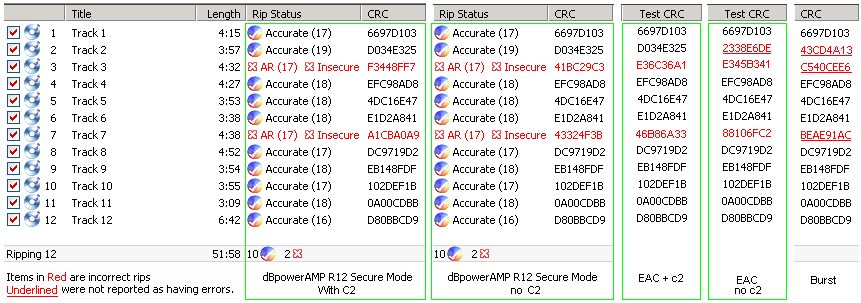
|
Program |
Tracks without Errors |
with Errors (errors
reported) |
with Errors (errors not reported) |
| dBpoweramp with c2 |
10 |
2 |
0 |
| EAC with c2 |
10 |
2 |
0 |
| dBpoweramp no c2 |
10 |
2 |
0 |
| EAC no c2 |
9 |
2 |
1 |
Plextor - PX230a
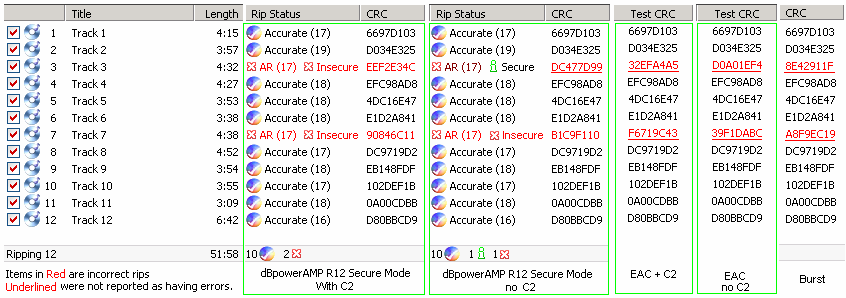
|
Program |
Tracks without Errors |
with Errors (errors
reported) |
with Errors (errors not
reported) |
| dBpoweramp with c2 |
10 |
2 |
0 |
| EAC with c2 |
10 |
0 |
2 |
| dBpoweramp no c2 |
10 |
1 |
1 |
| EAC no c2 |
10 |
0 |
2 |
Matshita - UJDA757
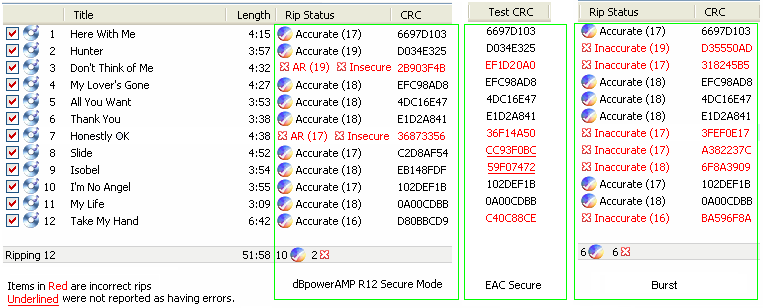
|
Program |
Tracks without Errors |
with Errors (errors
reported) |
with Errors (errors not reported) |
| dBpoweramp |
10 |
2 |
0 |
| EAC |
7 |
3 |
2 |
NEC - DVD-RW ND-2510A
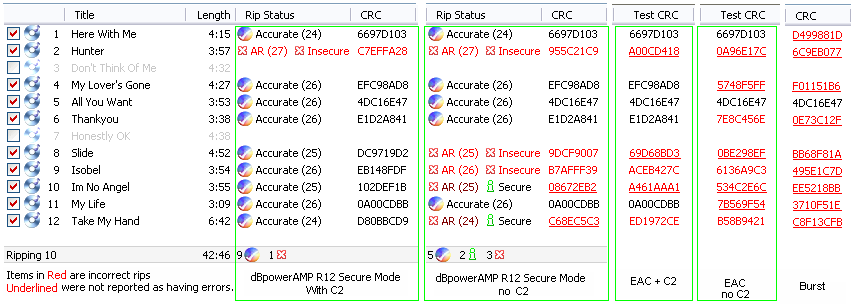
|
Program |
Tracks without Errors |
with Errors (errors
reported) |
with Errors (errors not
reported) |
| dBpoweramp with c2 |
9 |
1 |
0 |
| EAC with c2 |
5 |
2 |
3 |
| dBpoweramp no c2 |
5 |
3 |
2 |
| EAC no c2 |
2 |
3 |
5 |
Ripping Methods
New Ideas
Firstly we thought it was important to move away from the [read
block][re-read block] & compare method, this method jiggles the CD drive
backward and forward head many times a second causing stress to the
drive (in Illustrates opinion). A new strategy is to rip in complete
passes (AccurateRip is able to jump in and stop a rip after any pass it
if agrees with AccurateRip). In addition Ultra Secure passes can be used
to detect those hard to detect errors. These diagrams show different
ripping methods:
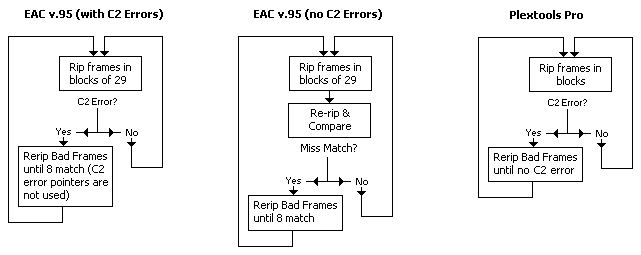
Plextools Pro relies 100% on C2 error pointers reporting the errors,
whilst on a drive with a good C2 error pointer implementation a very
high % of errors are detected, a small percentage do slip through
undetected.
EAC with C2 error detection on uses C2 pointers to detect errors, when
an error is found C2 error pointers are not used, that is why on the
above tests (with C2) EAC reported no errors on certain tests where C2
error pointers could have prevented that. Without C2 error pointers EAC
rips, then re-rips and compares - should an error be duplicated in both
reads it will pass through undetected.
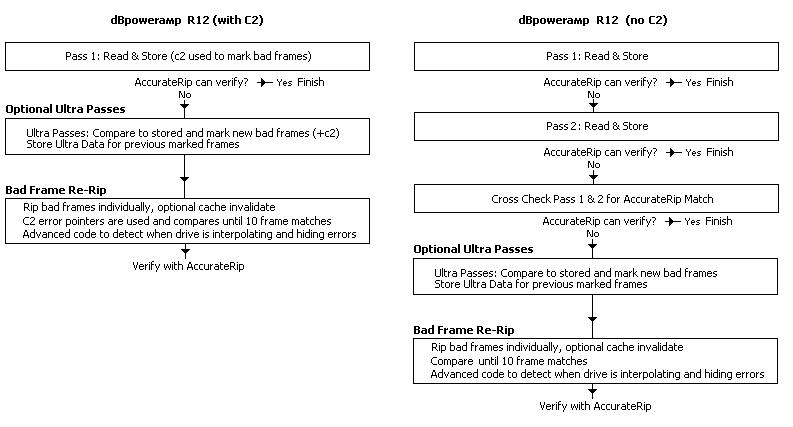
dBpoweramp's method is quite a bit different to the traditional Ripping
methods, using a concept of complete passes to identify errors and put
less physical stress on the drive. With C2 error pointers an optional
ultra pass can be used to identify errors which slip through the C2 net
(no matter how well C2 is supported on a drive). The re-rip code on
identified bad frames is pretty standard except we also implemented
routines to try to detect interpolation many drives do when there
is an error.
With no C2, there are always 2 passes after which a cross-check is done
against AccurateRip to determine if elements in each of the pass were
correct. Ultra passes are useful in detecting errors when C2 error
pointers are not supported, the Matshita drive especially needed the
extra passes to detect errors (sometimes detecting new errors 6 passes
in).
Copyright © illustrate 2026, All Rights Reserved